What size dehumidifier should I buy?
Oct 13, 2023
What size dehumidifier should I buy?
You must be thinking, why not buy a big dehumidifier for your place? Each zone has a different size, relative humidity, air flow, etc. Therefore, each location requires a specific dehumidifier.
For example, an empty warehouse with no one inside will have lower humidity. Because it essentially stays closed, no one can sweat and release excess moisture in the air. So, a place like this requires a standard size dehumidifier.
However, suppose there are hundreds of workers in a factory sweating, and humid air flows in from all directions, forming a unique humid space. Well, this factory will need more dehumidifiers, even though it is the same size as the above warehouse.
The size of your premises is one of the key factors in determining the capacity of your new dehumidifier.
"The rule of thumb is 1 liter per square meter of space."
Please note that this rule is only a general estimate for warehouses. Other areas may be different and may have babies or fewer needs.
For example, if you have an office hall of 500 square meters, a 500 liter/day dehumidifier will work.
But it should be noted that in terms of dimensions, not only length and width, but also the height of the building is important. We will discuss the impact of building height on dehumidification in the next heading;
Do you need a ceiling-mounted or vertical dehumidifier?
We all know that dehumidifiers come with basic installation options;
a) Ceiling dehumidifier
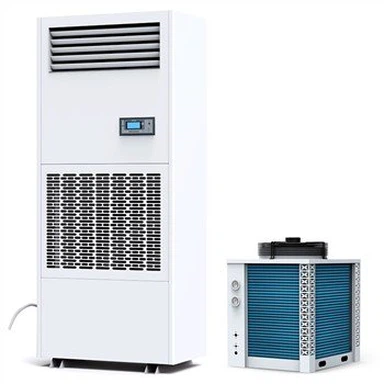
b) Vertical floor dehumidifier
Why choose a ceiling dehumidifier?
There is no doubt that vertical dehumidifiers are more famous and practical than ceiling dehumidifiers. But in some cases, a ceiling-mounted dehumidifier becomes necessary;
When a building is too tall
Let's say you have a factory with a roof 100 feet above the ground and enough dehumidifiers on the floor. However, they will never be powerful enough to draw air that high; they simply dehumidify the air at the ground level and ventilate the air near the ceiling.
Unfortunately, this moist air can lead to fungal growth and rust. Therefore, if you want to dehumidify the air above, you must install some dehumidifiers facing away from the ground. You can't install a vertical one because it's too complicated. What you need is the ceiling version.
when too small
Let's say you work in a place where every square foot counts, such as green rooms, basements, labs, and other areas. Then a ceiling dehumidifier may be your best choice.
For example, high-end laboratories are conducting experiments in controlled environments. Many complex systems are installed to control air quality such as humidity, moisture, bacteria and all other factors.
The cost of all these upgrades is also so that the lab typically grows and no space is wasted. , placing a vertical dehumidifier that barely controls the storage room is not efficient. This is why a good ceiling dehumidifier that can be installed in the ducts is the best choice.
Vertical floor dehumidifier
Vertical dehumidifiers are a better choice than ceiling-mounted dehumidifiers for the following reasons:
You can easily move them from one room to another or from one building to another. And the ceiling is fixed.
If you have a very large building and require a larger capacity dehumidifier, then vertical dehumidifiers are best as they increase in size, whereas ceiling-mounted dehumidifiers do not.
When damaged, you can easily repair them, whereas ceiling dehumidifiers are mounted high and difficult to access.
You can monitor your vertical dehumidifiers 24/7 and they are right in front of you. When an accident occurs, such as an electrical fire, you can resolve it quickly and avoid significant damage. While hidden ceiling dehumidifiers can't be monitored all the time, you can fix them quickly and avoid major damage. It can only be known if the damage has spread.
Replacement parts for upright dehumidifiers are more readily available than for ceiling-mounted dehumidifiers.
Vertical dehumidifiers are better than ceiling-mounted dehumidifiers in many ways. Their only drawback is that they take up more floor space and tend to be very tall building dehumidifiers.
How many dehumidifiers do you need to buy?
Let's say you have an area that is 100 meters long but only 20 meters wide, for a total of 2000 square meters ( 100 x 20 ).
So, based on the "1 liter per square meter" rule of thumb, you will need a dehumidifier with a capacity of 2000 liters per day. You may think that just buying a dehumidifier with a capacity of 2000 liters per day is enough. no, I can not.
The dehumidifier has a built-in fan that draws in breathing air from the surroundings. But the scope of what these fans can do is limited. The rule of thumb is;
"The fan power of a 250-liter dehumidifier can only cover an area of 10 meters in all directions."
Note that this rule only applies to repositories. In other areas, fans may cover the floor for babies or small children.
So, in the above example of a 100 meter long area, a dehumidifier with a capacity of 2000 liters would only be enough for a fan to pull air from a 40 meter area. At the same time, the remaining 60-meter area will not be properly dehumidified.
The solution is 4 dehumidifiers with a capacity of 500 liters/day. You can place them 25 meters apart from the starting point of the building to the purchase terminal. Each of them has a fan powerful enough to cover an area of 20 to 25 meters, so that with the same layout, the entire building can be properly dehumidified.
Choosing between portable vs fixed version?
Another important question you may have in mind if you are buying a vertical dehumidifier is, does it have wheels underneath it?
Among our recommendations, portable dehumidifiers are a better choice than stationary dehumidifiers because portable dehumidifiers are the same in design and functionality as stationary dehumidifiers. They have only one major difference: they have wheels underneath so you can move them around.
Suppose you own a marriage hall but don't know when or which one will be booked. In this case, purchasing one portable dehumidifier can do the job of purchasing multiple stationary dehumidifiers. It can be pushed from one hall to another by 2-3 people.
However, if you own a factory, warehouse, swimming pool, etc., and the train station is open, you know that the dehumidifier will not be moved for years. In this case, buy the fixed version.
Please note that larger dehumidifiers with capacities of several thousand liters per day do not offer portable options.